Magnesium Taurate Price Comparison — 2026
Magnesium taurate is magnesium bound to taurine — an amino acid that has its own effects on heart rhythm, blood vessel tone, and blood pressure. People take it most often for cardiovascular support: keeping resting blood pressure steady, easing palpitations, and pairing two ingredients that show up together in heart-health research. It is gentle on the stomach (no laxative effect at typical doses) and well-absorbed, but the elemental magnesium yield per gram of compound is low — varying by formulation, but always much less than the compound weight on the label. Most cardiovascular research uses 100–300 mg/day of elemental magnesium from taurate, often in two split doses.
This page compares magnesium taurate products by cost per month at a reference dose of 200 mg/day of elemental magnesium. Rankings are based on the amount of magnesium listed on the Supplement Facts label divided into the product's price. One product per brand in each table; lowest cost per month wins.
Current rankings: lowest cost per month at 200 mg/day
Prices as of June 18, 2026. Prices update daily; this page updates monthly. For current prices and full interactive filters, see the Magnesium Taurate compare page.
See all products with full filter and sort options →
Price spread
- Cheapest: BulkSupplements .com Magnesium Taurate Capsules - Magne… — $3.16/mo
- Most expensive: TRUEMED Natural Magnesium Taurate 1500mg – Magn… — $27.17/mo
- Spread: 8.6× premium across 22 qualifying products
What to look for
The "Magnesium" line is the number that matters — and the gap is large. Magnesium taurate labels show two numbers that look similar but mean very different things. Here's what to look for:
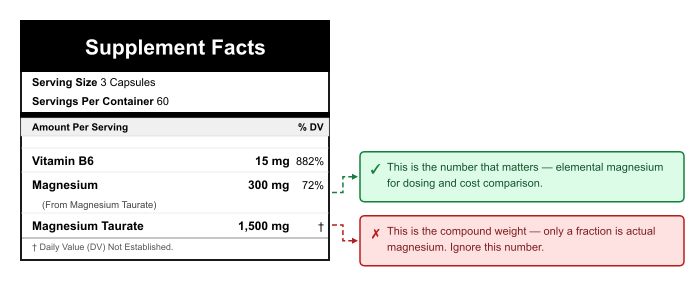
The line that reads "Magnesium (From Magnesium Taurate) — 300 mg" is the one that matters. That's the actual elemental magnesium per serving, and it's the number our rankings use for cost comparison.
The line below it — "Magnesium Taurate — 1,500 mg" — is the weight of the entire compound. Only a fraction of that weight is elemental magnesium, and the exact ratio varies by formulation. You can safely ignore the compound number when comparing products. TrueServing already pulls the elemental "Magnesium" number from the Supplement Facts panel, so the rankings here account for the difference.
Compound-only labels don't make the rankings. Some taurate products only print the compound weight ("Magnesium Taurate 1,500 mg") with no elemental magnesium line on the Supplement Facts panel. The exact elemental yield depends on the specific form of taurate used — back-calculating it from the compound weight isn't reliable. Those products are routed to manual review rather than getting an estimated number, so they won't appear in the rankings until the elemental amount is verified.
Combination magnesium products are excluded. "Mag Complex," "Tri-Mag," and "Magnesium Glycinate + Taurate" formulas list a single combined magnesium total without breaking out the taurate portion. Per-form magnesium can't be verified from those labels, so they're filtered out of this comparison. Pure-taurate products (with or without taurine, B6, or BioPerine as co-ingredients) are what populate the rankings.
Taurine on the label is normal. Magnesium taurate is, by definition, the magnesium salt of taurine — and many products also add free taurine on top. That's not a red flag and it doesn't dilute the magnesium content; it just means you're getting more total taurine per serving. If you also take a standalone taurine supplement, factor the added amount into your daily total.
Powder is rare and bulky for this form. Hitting 200 mg of elemental magnesium from taurate powder requires a large scoop — noticeably gritty with a slightly sulfurous taurine taste. Most products are capsules or tablets, typically delivering 100–300 mg of elemental magnesium per serving in 2–3 pills. The Powder table is sparse for this category as a result; that's expected, not a data issue.
Match the form to your goal. If your priority is cardiovascular support — blood pressure, palpitations, heart rhythm — taurate is the form most often studied for that use case. If you're after sleep and anxiety, Magnesium Glycinate has a longer track record and tends to cost less per elemental milligram. For cognitive research, Magnesium Threonate is the form that's been studied for brain delivery. For general repletion at the lowest cost, Magnesium Citrate, Magnesium Carbonate, and Magnesium Oxide all stretch each dollar further than taurate.
Evidence & safety
Magnesium repletion is the strongest claim across all magnesium forms — taurate is fine for that purpose, but it's not the cheapest path. The taurate-specific evidence centers on cardiovascular endpoints. Animal studies have shown blood pressure reduction and protection against arrhythmia and oxidative damage in hypertensive models; the human evidence is thinner — small trials and case series rather than large-scale RCTs — but the mechanism is plausible because both magnesium and taurine independently lower blood pressure and stabilize cardiac electrical activity. Most published cardiovascular protocols use 100–300 mg/day of elemental magnesium from taurate, often split between morning and evening; the 200 mg/day reference dose used here sits in the middle of that range. The NIH-set tolerable upper intake from supplements is 350 mg/day of elemental magnesium for adults — set to avoid loose stools, not toxicity — and 200 mg/day from taurate is comfortably below it. GI side effects are uncommon at this dose; taurate is one of the better-tolerated forms because the chelate doesn't dissociate readily in the gut. People with kidney disease should consult a clinician before supplementing magnesium of any form, since the kidneys clear excess. Magnesium also interacts with tetracycline and quinolone antibiotics, bisphosphonates, and prescription magnesium products — separate dosing by 2+ hours.