Magnesium Oxide Price Comparison — 2026
Magnesium oxide is the cheapest and most concentrated form of supplemental magnesium — more of each milligram is actual magnesium compared to other forms. People take it for three different reasons: as a short-term antacid for heartburn, as an osmotic laxative for occasional constipation, and as a daily mineral supplement. The tradeoff is that magnesium oxide is poorly absorbed compared to forms like Magnesium Glycinate or Magnesium Citrate, so the big number on the label doesn't translate cleanly into what your body actually uses. Typical daily doses for general supplementation run 250–500 mg.
This page compares magnesium oxide products by cost per month at a reference dose of 400 mg/day. Rankings are based on the amount of magnesium listed on the Supplement Facts label divided into the product's price. One product per brand in each table; lowest cost per month wins.
Current rankings: lowest cost per month at 400 mg/day
Prices as of June 18, 2026. Prices update daily; this page updates monthly. For current prices and full interactive filters, see the Magnesium Oxide compare page.
Powder
| Rank | Brand | Product | Form | Cost per month | Price |
|---|---|---|---|---|---|
| 1 | BulkSupplements | BulkSupplements.com Magnesium Oxide Powder - Magnesium Oxid… | Powder | $0.64 | $31.97 |
| 2 | Best Naturals | Best Naturals Pure Magnesium Oxide Powder 1 Pound | Powder | $0.66 | $14.99 |
| 3 | Vitamatic | Vitamatic Magnesium Oxide Powder – 1000 mg Per Serving – 25… | Powder | $0.80 | $9.99 |
| 4 | NOW Foods | NOW Foods Supplements, Magnesium Oxide, Enzyme Function*, N… | Powder | $0.90 | $9.90 |
Other forms (capsules, tablets, gummies)
| Rank | Brand | Product | Form | Cost per month | Price |
|---|---|---|---|---|---|
| 1 | Best Naturals | Best Naturals Magnesium Oxide 500mg 360 Tablets - 1 Year Su… | Tablets | $1.27 | $18.99 |
| 2 | Swanson | Swanson Magnesium Bone & Muscle Health Support 200 Milligra… | Capsules | $1.37 | $11.39 |
| 3 | Carlyle | Carlyle Magnesium Oxide 500mg | 120 Capsules | Premium Qu… | Capsules | $1.50 | $7.49 |
| 4 | Horbäach | Horbäach Magnesium Oxide 865 mg | 200 Capsules | Non-GMO… | Capsules | $1.56 | $12.99 |
| 5 | Heivy | Heivy Magnesium Oxide 400mg – Magnesium Supplement for Supp… | Tablets | $1.75 | $6.99 |
See all products with full filter and sort options →
Price spread
- Cheapest: BulkSupplements .com Magnesium Oxide Powder - Magnesium… — $0.64/mo
- Most expensive: SmildeHeal Magnesium Oxide Gummies 400mg, Chewable… — $11.99/mo
- Spread: 18.7× premium across 42 qualifying products
What to look for
The "Magnesium" line is the number that matters. Magnesium oxide labels show two numbers that look similar but mean different things. Here's what to look for:
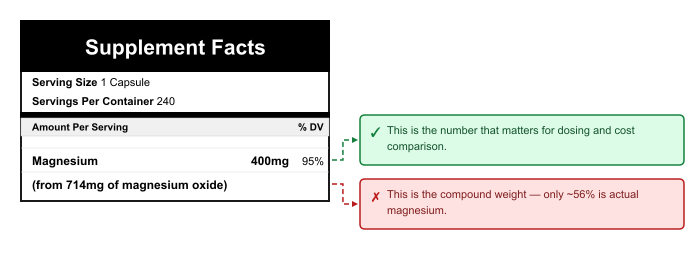
The line that reads "Magnesium — 400mg" is the one that matters. That's the amount of magnesium you're actually getting per serving, and it's the number our rankings use for cost comparison.
The parenthetical "from 714mg of magnesium oxide" is the total compound weight. Magnesium oxide is more concentrated than most forms (~56% magnesium vs ~20% for Magnesium Malate or ~30% for Magnesium Citrate), but the compound number still overstates what you're getting.
TrueServing already extracts the correct number for you — every product in our rankings uses the magnesium amount from the Supplement Facts label, not the compound weight.
Match the form to your goal. If you're taking magnesium for occasional constipation or as an antacid, oxide is a sensible, cheap fit — that's where most clinical and OTC use sits. If your goal is sleep, muscle relaxation, or raising magnesium levels, Magnesium Glycinate is better tolerated and better absorbed. If you want a mild laxative effect alongside repletion, Magnesium Citrate absorbs better than oxide while keeping some of the same gut effect. For cognitive-specific research, Magnesium Threonate is the form being studied. Buying the cheapest form isn't a win if not enough of it gets into your bloodstream.
Watch for blends without per-form breakdown. Many "Tri-Mag," "Magnesium Complex," and "Cal-Mag" products combine oxide with other forms and only list a total magnesium number. These are excluded from the rankings because the oxide content can't be verified. If you specifically want oxide for its laxative or antacid effect, look for single-form products.
Expect more GI side effects per mg than other forms. Magnesium oxide draws water into the gut — that's the same mechanism that makes it a laxative — so loose stools and cramping show up at lower doses than with glycinate. Splitting the daily dose across 2–3 smaller servings with food usually helps. If your stomach can't tolerate it at the dose you need, switching forms is more practical than reducing below an effective amount.
Treat OTC laxative and antacid use as short-term. Bottle labels for those uses typically cap recommended duration at one to two weeks. Daily supplementation at 250–500 mg is a different use case and is generally fine for healthy adults — but if you're reaching for magnesium oxide for chronic constipation or chronic heartburn, that's worth a conversation with a doctor.
Evidence & safety
Magnesium oxide is a well-established osmotic laxative and antacid — that's the strongest evidence behind it. For raising magnesium levels, it works at high enough doses but is less efficient than Magnesium Glycinate or Magnesium Citrate — head-to-head studies consistently show lower absorption from oxide. Migraine-prevention evidence at 400–500 mg/day is moderate, drawn from several small randomized trials. The NIH tolerable upper intake from supplements is 350 mg/day for adults to avoid loose stools and cramping; oxide hits that threshold faster than other forms because of its osmotic effect, so a 400 mg/day dose may not be tolerated as a single daily serving. People with kidney disease should not take supplemental magnesium without medical supervision. Common interactions include certain antibiotics (tetracyclines, quinolones), bisphosphonates, and some diuretics — spacing doses by a few hours usually prevents the issue.