Magnesium Malate Price Comparison — 2026
Magnesium malate is magnesium bound to malic acid — the compound that gives apples and other fruits their tart taste. People take it for general magnesium repletion, muscle cramps, fatigue, and chronic pain conditions like fibromyalgia. Some users prefer it for daytime use because malic acid plays a role in cellular energy production, while heavier-feeling forms like Magnesium Glycinate are often saved for sleep. Most clinical magnesium research uses 300–450 mg per day, taken with meals.
This page compares magnesium malate products by cost per month at a reference dose of 400 mg/day. Rankings are based on the amount of magnesium listed on the Supplement Facts label divided into the product's price. One product per brand in each table; lowest cost per month wins.
Current rankings: lowest cost per month at 400 mg/day
Prices as of June 17, 2026. Prices update daily; this page updates monthly. For current prices and full interactive filters, see the Magnesium Malate compare page.
Powder
| Rank | Brand | Product | Form | Cost per month | Price |
|---|---|---|---|---|---|
| 1 | Nutricost | Nutricost Magnesium Malate Powder (300g) - 420mg of Magnesi… | Powder | $4.39 | $21.95 |
Other forms (capsules, tablets, gummies)
| Rank | Brand | Product | Form | Cost per month | Price |
|---|---|---|---|---|---|
| 1 | Horbäach | Horbäach Magnesium Malate | 1800mg | 250 Caplets | Veget… | Tablets | $2.81 | $6.99 |
| 2 | Source Naturals | Source Naturals Magnesium Malate - 3750mg Per Serving - Ess… | Tablets | $7.05 | $14.98 |
| 3 | Carlyle | Carlyle Magnesium Malate | 1800mg | 420 Coated Caplets |… | Tablets | $7.24 | $17.49 |
| 4 | Nutricost | Nutricost Magnesium Malate 2,100mg, 180 Capsules - Vegetari… | Capsules | $7.60 | $15.95 |
| 5 | P Puregen Labs | Puregen Labs Magnesium Malate 500mg | High Potency Element… | Capsules | $8.42 | $18.95 |
See all products with full filter and sort options →
Price spread
- Cheapest: Horbäach Magnesium Malate | 1800mg | 250 Caplets… — $2.81/mo
- Most expensive: Whoyun Magnesium Malate Gummies 1000mg, Enhanc… — $53.31/mo
- Spread: 19.0× premium across 27 qualifying products
What to look for
The "Magnesium" line is the number that matters. Magnesium malate labels can show two different numbers that look similar but mean very different things. Here's what to look for:
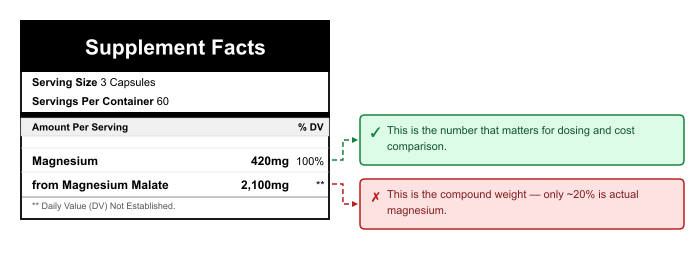
The line that reads "Magnesium — 420mg" is the one that matters. That's the amount of magnesium you're actually getting per serving, and it's the number our rankings use for cost comparison.
The parenthetical "from 2,100mg of magnesium malate" is the total compound weight — magnesium plus malic acid together. Only about 20% of that weight is actual magnesium. You can safely ignore the compound number when comparing products.
TrueServing already extracts the correct number for you — every product in our rankings uses the magnesium amount from the Supplement Facts label, not the compound weight.
Same compound weight, different magnesium. This is the real gotcha. Two products can both say "from 1,800 mg of Magnesium Malate" but deliver very different amounts of magnesium — one might provide 360 mg per serving while another provides 207 mg. The difference comes down to the specific type of magnesium malate used (some formulations bind more magnesium per molecule than others). Don't compare products by compound weight; compare them by the "Magnesium" line. TrueServing's rankings already do this.
Di-magnesium malate delivers more magnesium per gram. Some labels specify "as di-magnesium malate," which binds two magnesium atoms per malate molecule instead of one. These products tend to pack more magnesium into fewer capsules or a smaller scoop. It doesn't change what you're getting per milligram of magnesium — it just means the capsules are more efficient. You'll sometimes see a powder product deliver 420 mg from a single 2g scoop while a capsule product needs 3 caplets to reach a similar amount.
Most products require 3 capsules or tablets per serving. The majority of magnesium malate products use a 3-count serving size (caplets, tablets, or capsules). Powder is the exception — a single scoop gets you a full serving. If swallowing multiple pills daily matters to you, check the "Serving Size" line, not just the per-serving magnesium amount.
Combination products and "magnesium complex" blends. Magnesium malate sometimes appears in blends with other forms (Magnesium Glycinate, Magnesium Citrate, Magnesium Taurate). If a product lists only a total "Magnesium Blend" with no per-form breakdown, the malate content can't be verified — these don't make it into the rankings.
Daytime vs. nighttime use. If you tolerate magnesium malate well during the day, this form fits naturally into a morning or with-lunch routine. For sleep-specific use, Magnesium Glycinate is the more common choice; for cognitive support, Magnesium Threonate is the form studied in brain research.
Evidence & safety
Magnesium itself has strong evidence for correcting deficiency, easing constipation, and modestly lowering blood pressure; the malate-specific benefits are less well-established. Small trials in fibromyalgia patients using 300–600 mg of magnesium combined with malic acid showed reduced pain and tender points, but a 2021 review of 11 studies concluded the overall evidence was weak. Energy and exercise-recovery claims are emerging rather than proven. The NIH-set tolerable upper intake from supplements is 350 mg/day for adults — set to avoid GI side effects, not toxicity — and doses above this are common in research and generally well-tolerated. Loose stools and abdominal cramping are the most frequent side effects. People with kidney disease should consult a doctor before supplementing, since the kidneys clear excess magnesium.