Magnesium Carbonate Price Comparison — 2026
Magnesium carbonate is one of the cheapest sources of supplemental magnesium per dollar. It pulls double duty in the stomach — neutralizing acid the way an antacid does, then converting to magnesium chloride and getting absorbed in the small intestine. People take it for general magnesium repletion, especially when they want a high mg-per-pill product to keep daily capsule counts low. Absorption per dose is lower than organic forms like Magnesium Glycinate, Magnesium Citrate, or Magnesium Malate, but the price gap is large enough that the cheapest carbonate products often deliver more magnesium per dollar than any other form. Most clinical magnesium research uses 200–400 mg/day, taken with food.
This page compares magnesium carbonate products by cost per month at a reference dose of 400 mg/day. Rankings are based on the amount of magnesium listed on the Supplement Facts label divided into the product's price. One product per brand in each table; lowest cost per month wins.
Current rankings: lowest cost per month at 400 mg/day
Prices as of June 18, 2026. Prices update daily; this page updates monthly. For current prices and full interactive filters, see the Magnesium Carbonate compare page.
Powder
| Rank | Brand | Product | Form | Cost per month | Price |
|---|---|---|---|---|---|
| 1 | PURE ORIGINAL INGREDIENTS | Pure Original Ingredients Magnesium Carbonate, Magnesium Su… | Powder | $1.19 | $22.49 |
| 2 | BulkSupplements | BulkSupplements.com Magnesium Carbonate Powder - Magnesium… | Powder | $1.38 | $28.97 |
| 3 | PURE ORIGINAL INGREDIENTS | Pure Original Ingredients Magnesium Carbonate (8oz) Magnesi… | Powder | $2.12 | $9.99 |
Other forms (capsules, tablets, gummies)
| Rank | Brand | Product | Form | Cost per month | Price |
|---|---|---|---|---|---|
| 1 | Planetbee | Planetbee Magnesium Carbonate Capsules, 500 mg Magnesium Su… | Capsules | $4.72 | $17.69 |
| 2 | Youlikee | 2 Pack Magnesium Carbonate 500mg Gummies, High Absorption M… | Gummies | $5.20 | $12.99 |
| 3 | duwhot | duwhot Magnesium Carbonate 500mg, High Absorption Supplemen… | Capsules | $5.86 | $21.99 |
| 4 | GREABBY | Magnesium Carbonate 500mg Gummies, Magnesium Supplement for… | Gummies | $15.99 | $19.99 |
See all products with full filter and sort options →
Price spread
- Cheapest: PURE ORIGINAL INGREDIENTS Magnesium Carbonate, Magnesium Suppleme… — $1.19/mo
- Most expensive: GREABBY Magnesium Carbonate 500mg Gummies, Magn… — $15.99/mo
- Spread: 13.4× premium across 12 qualifying products
What to look for
The "Magnesium" line on the Supplement Facts panel is the number that matters. Magnesium carbonate labels typically show two related numbers — one for the magnesium and one for the total compound weight. Here's what to look for:
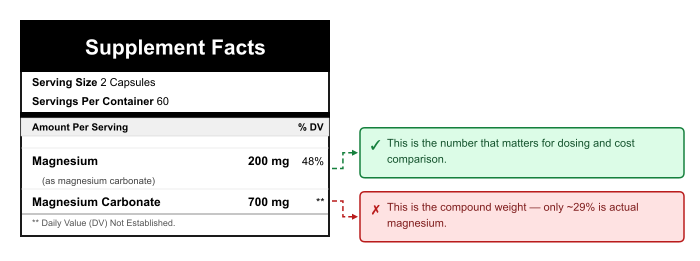
The line that reads "Magnesium (as magnesium carbonate) — 200 mg" is the one that matters. That's the amount of magnesium you're actually getting per serving, and it's the number our rankings use for cost comparison.
The line above or below it — "Magnesium Carbonate — 700 mg" — is the weight of the entire compound, which is only about 29% magnesium. You can safely ignore that number when comparing products.
A few products use "Magnesium (as magnesium hydroxy carbonate)" instead. Hydroxy carbonate is a specific mineral form of magnesium carbonate — you'll see it on labels of pharmacopoeial-grade products. For daily-supplement comparison, treat it as the same active. TrueServing's rankings already pull the "Magnesium" number from the Supplement Facts panel and treat both label variants the same way.
Cal-Mag and "calcium-magnesium" combos don't make the rankings. Calcium carbonate and magnesium carbonate often share a label — sometimes as a deliberate Cal-Mag formula, sometimes as a stomach-soothing combo product. When the magnesium content depends on a blend, per-form magnesium can't be verified, so those products are excluded from the cost comparison here.
Antacid chewables vs. daily-supplement products. Some carbonate products are sold as chewable antacids — taken as needed for heartburn, often combined with aluminum hydroxide or simethicone — rather than as a daily magnesium source. The serving instructions are dose-as-symptoms-warrant, which doesn't translate cleanly to a cost-per-month metric. The rankings here focus on capsule, tablet, and food-grade powder products positioned for consistent daily intake.
Powder is uncommon for this form. Magnesium carbonate is a chalky, off-white powder with poor water solubility — it doesn't dissolve cleanly the way Magnesium Citrate does, and the texture is gritty even in juice or a smoothie. The Powder table is sparse for this category as a result. Most carbonate products are capsules or tablets, frequently delivering 250–500 mg of magnesium per pill — that high cap-density is one of the reasons carbonate stays popular despite its bioavailability profile.
Don't confuse supplement-grade carbonate with gym chalk. Climbing chalk and lifting chalk are also magnesium carbonate, but they're a topical drying agent for hands — not a dietary supplement, and not what you'll find in this comparison. Supplement-grade product comes in capsules, tablets, or food-grade powder; chalk-grade product comes in blocks, loose chalk, or liquid chalk for a chalk bag.
Evidence & safety
Evidence for magnesium repletion is strong, and magnesium carbonate is an accepted source for both general supplementation and OTC antacid use. Head-to-head bioavailability studies consistently rank carbonate below organic forms like glycinate, citrate, and malate; absorption depends partly on stomach acid because carbonate has to convert to magnesium chloride before it can cross the gut wall, so people on acid-suppressing medication (PPIs, H2 blockers) may absorb less from this form than from organic alternatives. That said, total magnesium intake matters more for correcting deficiency than per-dose absorption efficiency — the body absorbs more efficiently when stores are low, and even modestly absorbed forms can restore status given enough total dose. The NIH sets a tolerable upper intake of 350 mg/day from supplements (set to avoid GI side effects, not toxicity); the 400 mg/day reference dose used here is consistent with the broader magnesium-series convention and reflects the typical clinical research dose. Loose stools and stomach upset are the most common side effects; people with kidney disease should consult a clinician before supplementing, since the kidneys clear excess magnesium. Magnesium also interacts with tetracycline and quinolone antibiotics, bisphosphonates, and prescription magnesium products — separate dosing by 2+ hours. For a better-tolerated and better-absorbed alternative, glycinate is the most common choice; for cognitive-specific research, see Magnesium Threonate; for a similarly low-cost inorganic form, Magnesium Oxide covers the same general use case with a slightly different absorption profile.